

St. Paul’s Albanian Catholic Church
Thursday, 26 August 2010

Mother Teresa: *Do It ANYWAY
By: Franz-Llesh Grishaj
It is truly an honor to be with you on this solemn and joyous occasion of the dedication of the newly erected Mother Teresa statue, generously donated by the brothers Leka and Pashko Gojcaj, as we commemorate the 100th anniversary of the birth of the Blessed Teresa of Calcutta, more commonly known as Mother Teresa; and by her dearest admirers simply called “Mother.”
As an Albanian-American Community, we are extremely happy with today’s scheduled events in remembrance of Mother Teresa that will take place not only at St. Paul’s Albanian Catholic Church but also throughout the globe as the Catholic Church, Albanians world-wide (regardless of religious affiliations), and all people of good-will are commemorating her centennial. However, I am also aware that many of our people, here and abroad, once again feel irritated as we did during her beatification with the reemergence of so-called scholarly and diplomatic bickering over her legacy. Moreover, the senseless criticism against the U.S. Postal Service for issuing a commemorative stamp in honor of Mother Teresa compounded with the owner of the Empire State Building, Mr. Anthony Malkin, denying the Catholic League’s request for the building’s iconic lightings featuring blue and white in tribute of Mother Teresa’s centenary only adds to our frustration.
[As a footnote, the Catholic League submitted its request on 2 February and was officially denied on 5 May without any explanation. Afterwards, as a means of justifying their decision a new paragraph was amended stating “…the Empire State Building has a specific policy against lighting for religious figures, religious organizations …” Furthermore, precedent had been set in which this great landmark could honor achievers or achievements when deemed fitting and proper. Does not Mother Teresa’s greatest compare with the 60th anniversary of the Chinese Communist revolution?]
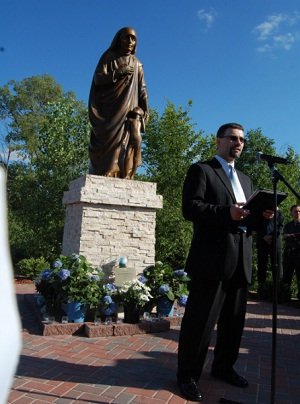
Regardless, as a people of faith, desiring only to honor our beloved sister and mother, I respectfully suggest that we do not allow ourselves to become preoccupied with these distractions. Instead, let us in mind, body, and spirit totally dedicate ourselves to this historic day as we pay homage to truly “one of the greatest missionaries of the 20th century” as described by Pope John Paul II.
In referring to Mother Teresa, many wonderful names have been affectionately bestowed on her: “Living Saint,” “Saint of the Gutters,” “God’s Gift,” “God’s Pencil,” “Apostle of Joy,” “Courageous Missionary,” just to name a few. She, however, confessed that “The title of ‘Mother’ is the biggest honor I have ever received.” Knowing the intimate spiritual relationship she had with the Blessed Virgin Mother Mary, no one could doubt her sincerity. Yet, if I could choose a word, title, that would best identify her, it would be a “mystic” – yes, a modern-day mystic. Mother Teresa was a traditional Christian mystic in the purest sense as her “call within a call” truly exemplified her unique and exceptionally profound experience of oneness with God.
In addition, we are fortunate for the tremendous amount of inspirational testimonies, biographies, and scholarly work on Mother Teresa, not to mention her own personal writings. This gives any researcher an immeasurable wealth of information to work with. My primary focus will be on a well-known poem attributed to Mother Teresa. After much contemplation, I will be examining the genuine spiritual message that I feel the poem conveys; and then I will illustrate how Mother Teresa and the Missionaries of Charity have personified it. By no means, however; does this imply that there can be only one interpretation.
Here it is.
*“ANYWAY”
People are often unreasonable, illogical and self centered;
LOVE THEM ANYWAY.
If you are kind, people may accuse you of selfish, ulterior motives;
BE KIND ANYWAY.
If you are successful, you will win some false friends and some true enemies;
SUCCEED ANYWAY.
If you are honest and frank, people may deceive you;
BE HONEST AND FRANK ANYWAY.
What you spend years building, someone could destroy overnight;
BUILD ANYWAY.
If you find serenity and happiness, they may be jealous;
BE HAPPY ANYWAY.
The good you do today, people will often forget tomorrow;
DO GOOD ANYWAY.
Give the world the best you have, and it may never be enough;
GIVE THE WORLD THE BEST YOU’VE GOT ANYWAY.
You see, in the final analysis, it is between you and God;
IT WAS NEVER BETWEEN YOU AND THEM ANYWAY.
The simplicity of this poem, uniquely insightful in nature, is so philosophically, theologically, and spiritually significant because, not only does it clearly describe the fundamental principles of fidelity, hope, service, compassion, and love that Mother Teresa, and the Missionaries of Charity, are renowned for in serving “the poorest of the poor.” It also resonates the essential teaching of the Gospel that these core values epitomize, which according to Mother Teresa is, “Jesus came to teach us: that God loves us, and that He wants us to love one another as He loves us.” So intrinsically imbedded was this belief that she repeatedly stated, “Our mission is to convey God’s love – not a dead God but a living God, a God of love.” This love that consumed and drove Mother Teresa is Almighty God Himself because Sacred Scripture assured her, and all of us, that, “God is love, and whoever remains in love remains in God and God in him” (1 John 4:16).
More importantly, who was this “God of love” that transformed Mother Teresa’s entire-being? The answer for her was, and will always be, Jesus. She wrote, “To me – Jesus is my God. Jesus is my Spouse. Jesus is my Life. Jesus is my only Love. Jesus is my All in All. Jesus is my Everything!”
This “God of love” exalted Mother Teresa to see, through the lenses of her soul, the spiritual reality that “we all have been created in the image of God to love and to be loved.” Therefore, she was inspired with word and deed to express that “It is not enough for us to say: ‘I Love God,’ but I also have to love my neighbor.” It is apparent that this intrinsic truth is the summation of the Ten Commandments: “You shall love the Lord, your God, with all your heart, with all your soul, with all your strength, and will all your mind, and your neighbor as yourself” (Luke 10:27). This empowering conviction, as the poem suggests, encouraged her, and challenges us, to love unconditionally, to be kind, to succeed, to be truthful, to build, to be happy, to do good, and to give your best to the world. For it is comprised of all of God’s children – irrespective of social class, ethnic origin, or profession of faith – and hence, according to Mother Teresa, “There is only one God and He is God to all; therefore it is important that everyone is seen as equal before God.”
As described by this poem, there is a fundamental difference in how Mother Teresa perceived “love your neighbor as yourself.” I believe that her understanding of “love of neighbor” is not confined to the “Golden Rule” which states, “Do to others whatever you would have them do to you.” (Matthew 7:12). While this teaching is cherished, it is people loving others according to their limited human awareness of what they perceive others may want, or need, solely based on their personal disposition. To a mystic, however, what is absent here is the essential component of oneness with God. On the other hand, Mother Teresa’s tangible representation of how to love your neighbor is most evident in the Last Supper. There, Jesus the “Teacher” and “Lord” goes against the cultural norms of the time by washing his disciples’ feet and then says to them, “I have given you a model to follow, so that as I have done for you, you should also do” (John 13:15). Afterwards, Jesus gives them a new commandment to “Love one another as I have loved you” (John 13:34), and stipulates that “This is how all will know that you are my disciples” (John 13:35). You see, there is absolutely no reciprocity involved and this loving act of service is actually fashioned by her Lord and her God. Simply “Whoever loves me will keep my word” (John 14:23). Mother Teresa, a true disciple in complete union with God, incorporated this model and completely infused it into the Missionaries of Charity.
When Mother Teresa begins to THIRST for “the unwanted, the unloved, the uncared for” she is inflamed with the realization that she is literally caring for her “Crucified Spouse” and as a direct result sees “God in every human being.” This deep revelation expressed in the Gospel message of the Last Judgment became the basis of her entire ministry: “For I was hungry and you gave me food, I was thirsty and you gave me drink, a stranger and you welcomed me, naked and you clothed me, ill and you cared for me, in prison and you visited me.” Then the righteous will answer him and say, “Lord, when did we see you hungry and feed you, or see you thirsty and give you drink?”… The king will say to them in reply, “Amen, I say to you, what ever you did to the least of my brethren, you did it to me” (Matthew 25: 35-40). The last stanza of the poem unequivocally supports this profound belief; that whatever we do to each other, good or evil, we are actually doing it to God.
Mother Teresa’s resolve to “Do something beautiful for God” by seeking, finding, and serving Jesus in a most “distressing disguise” is purely remarkable and incomprehensible, especially considering the nearly 50 years of “intense spiritual darkness” that she suffered. Her uncompromising fidelity, accurately portrayed by this poem, of doing it anyway, is truly inspirational and, perhaps, almost overwhelming. Yet with “only blind faith” and the belief in prayer, as her source of strength, Mother Teresa continued with the fruit of love, which springs forth service, and served with joy, knowing that “God loves a cheerful giver” (2 Corinthians 9:7).
I believe that this intrinsic quality of faithfulness to the very end is also derivative of her cultural heritage. Having been raised in a traditional patriotic Albanian family by devout Catholic parents, Mother Teresa at an early age must have experienced the Albanian Besa. The besa is more than just a word; it is a concept of sacredness stemming from a person’s word of honor, which may be either a sworn oath or pledge. Once the besa has been given, one is bound by it. Thus, I lay claim that the day Mother Teresa made her Perpetual Profession; she freely and lovingly gave her besa, becoming, as she so often said, the “spouse of Jesus” for “all eternity.” At this moment, I am once again reminded from Sacred Scripture, “Whoever sows bountifully will also reap bountifully” (2 Corinthians 9:6) and, thus, can visualize Jesus saying to Mother Teresa, “Well done my good and faithful servant…come share your master’s joy.” (Matthew 25:21).
In conclusion, I reaffirm that this eloquent poem, with deep spiritual truths of elegant beauty, illuminates Mother Teresa and her ministry as personified through the Gospel’s eternally mandated message: God loves us and He wants us to love each other like He loves – unconditionally! Therefore, we should love as He taught us to love. Furthermore, if we meditate on the following saying by Mother Teresa, “True holiness consists in doing the will of God with a smile” and interweave it with the belief that God is holy and therefore also wants’ us to be holy, then this poem also explicitly demonstrates that holiness can truly be achieved in this world through very simple means – “to love as He loved us” – therefore inspiring all of God’s children to smile as we do it ANYWAY!
Thank you for your attentiveness.
God bless you!
Mother Teresa, continue to share with us;
Mother Teresa, continue to care for us;
Mother Teresa, continue to comfort us;
Mother Teresa, continue to pray for us;
Mother Teresa, continue to love us;
Mother Teresa, happy birthday.
* Although this particular version of the poem is attributed to Mother Teresa and found engraved on the wall of Shishu Bhavan, Mother Teresa’s home for children in Calcutta. It is believed to be based on The Paradoxical Commandments written by Kent Keith in 1968.